








When your radiators stop doing their job, it’s easy for frustration to set in – especially when you’re relying on them to keep your home warm and comfortable. The good news is that most radiator issues have straightforward causes and simple solutions. This guide covers the most common reasons radiators fail and shows you how to get them working efficiently again.
1. Trapped air in the radiator
Symptom: warm at the top, cold at the bottom – or noisy
One of the most common reasons for a radiator not heating up fully is trapped air. When air gets into your central heating system, it creates pockets that prevent hot water from circulating properly. This often results in a radiator that’s warm at the top but cold at the bottom, and can also cause gurgling or banging noises.
The fix – bleed your radiator
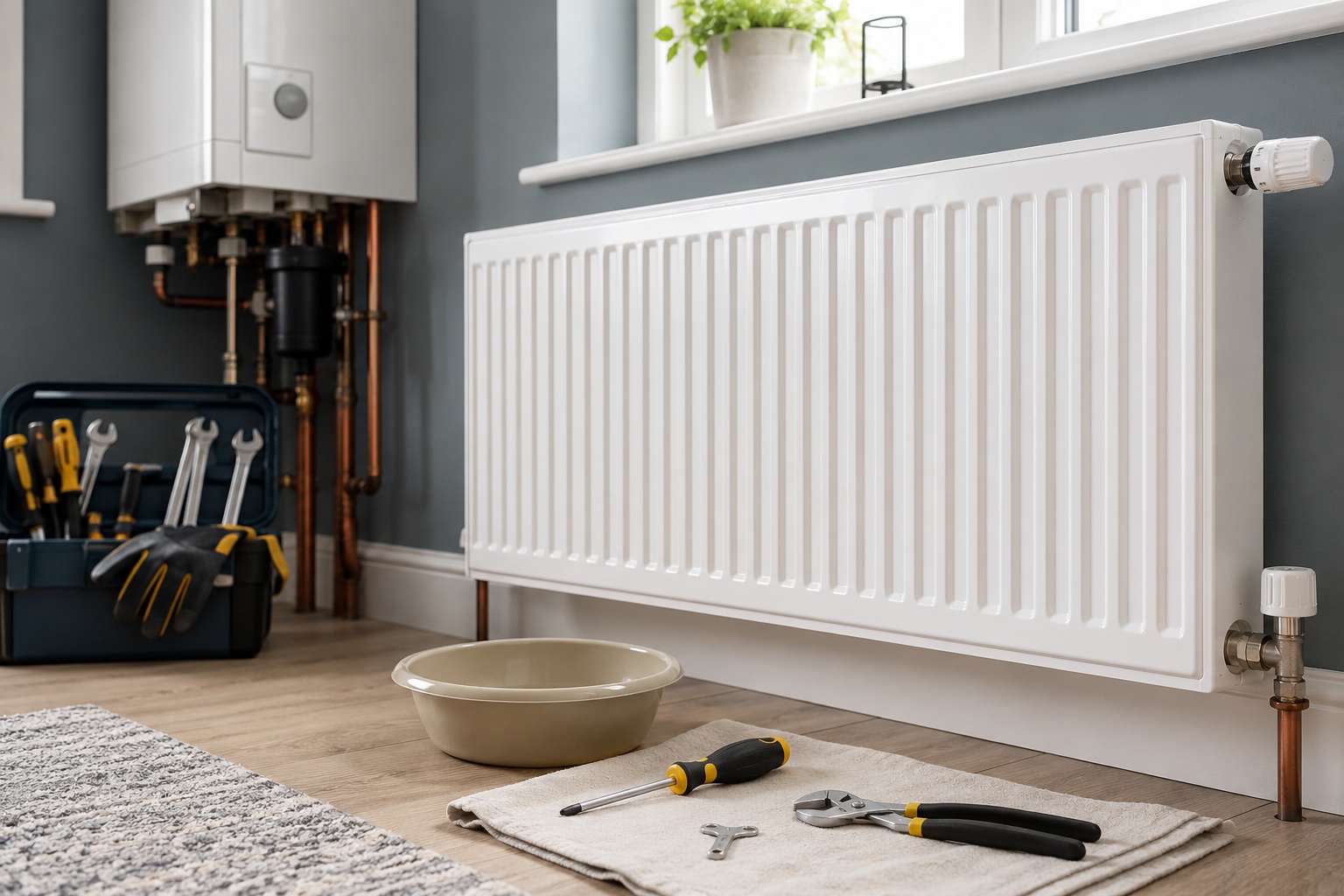
Use a radiator key to open the bleed valve (usually at the top of the radiator) and hold a cloth underneath to catch any drips. Let the air escape until water starts to flow out steadily, then close the valve and check your boiler pressure hasn’t dropped. If bleeding doesn’t fully solve the problem, air can move around after the first bleed – try again before assuming a bigger issue.
2. Sludge, debris or blockages
Symptom: cold at the bottom, warm at the top
Over time, rust, sludge and debris accumulate in radiators and pipes. This build-up restricts the flow of hot water, causing radiators to heat unevenly or not at all. Sludge settles at the lowest point and stops hot water from circulating through that section – which is why the bottom stays cold while the top stays warm.
The fix – power flush
A power flush uses high-pressure water to clean out radiators and pipes. This is not a DIY job – call a professional heating engineer to carry it out safely. Adding a magnetic filter to your system afterwards can prevent sludge from building up again.
3. Leaking radiator
Symptom: damp patches, visible water, or dropping pressure
Your radiator may be leaking due to corrosion in the system or loose and worn valves and fittings. Even a small leak can reduce system pressure enough to affect heating throughout your home. Dry the radiator with a towel and use tissue paper to check every joint and valve to find the source.
How to repair a leaking radiator valve
- Drain the system: turn off the supply valve and the lockshield valve, counting how many turns it takes. Use towels and a bowl to catch any excess water.
- Undo the union nut between the feeder pipe and the radiator.
- Open the bleed valve to let remaining water drain into the bowl.
- Wrap the valve tail with PTFE tape (plumber’s tape) 10–15 times.
- Retighten the union nut and reopen both valves by the same number of turns.
- Once water has returned to the system, check again for leaks, then close the bleed valve.
If the leak is coming from a hole within the radiator body itself, you’ll need a full replacement. Isolate the radiator by closing both valves until a new one is fitted.
4. Faulty or incorrectly set thermostatic radiator valves (TRVs)
Symptom: whole radiator cold despite heating being on
TRVs regulate the flow of hot water into your radiator based on room temperature. If the valve is set too low, or has seized in the closed position, it will prevent the radiator from heating up at all. First check that the dial is set high enough – then check whether the valve has seized.
How to check if the TRV has seized
- Remove the plastic top cover from the valve.
- Undo the knurled (ridged) nut by hand.
- Check that the centre pin moves freely up and down a few millimetres.
- If it’s stuck, apply penetrating oil such as WD-40 and gently tap or wiggle it with pliers.
- If the pin still won’t move, the valve needs replacing – call a professional.
5. Closed or stuck lockshield valves
Symptom: one radiator cold, others working fine
Lockshield valves balance the flow of water across your central heating system. Found on the opposite side of the radiator to the TRV and covered by a plastic cap, if one is closed or stuck it will cut off the hot water supply to that radiator entirely. Remove the cap and check whether the valve is open – if it’s stuck, try loosening it gently with a spanner. Do not force it, as this can cause damage.
6. Incorrectly balanced system
Symptom: some radiators hot, others lukewarm
If your central heating system isn’t properly balanced, some radiators will receive more hot water than others. Radiators closest to the boiler tend to get the most heat, while those further away stay cooler. Balancing involves adjusting the lockshield valves on each radiator to distribute hot water more evenly – if you’re not confident doing this yourself, call a professional heating engineer.
7. Low boiler or water pressure
Symptom: multiple radiators not heating
Low water pressure means there isn’t enough force to push hot water around the circuit effectively. Check the pressure gauge on the front of your boiler – the ideal reading is usually between 1 and 2 bar. If it’s below 1 bar, repressurise the system using the filling loop (refer to your boiler’s manual). If pressure keeps dropping, there may be a leak in the system that needs investigating.
8. Faulty boiler or pump
Symptom: all radiators cold despite the boiler firing
If your boiler or circulation pump isn’t working properly, it affects your entire central heating system. A failing pump may not circulate hot water effectively around the system, leaving all radiators cold. If you suspect a boiler or pump fault, call a qualified Gas Safe heating engineer – don’t attempt to fix this yourself.
9. Blocked or leaking pipes
Symptom: cold radiator with damp walls or floor nearby
Blocked or leaking pipes restrict the flow of hot water to your radiators. Blockages are usually caused by sludge or debris; leaks cause a gradual loss of system pressure. Inspect the pipes around your radiators for signs of dampness or corrosion. If you find a blockage, the system may need power flushing. Any leak should be repaired as soon as possible to prevent damage to your home’s structure.
10. Incorrect radiator size
Symptom: radiator working but room stays cold
If your radiator is too small for the room, it will struggle to heat the space effectively – even when it’s working exactly as it should. Calculate the BTU (heat output) required for your room size before choosing a replacement. If a larger radiator isn’t practical, consider adding a secondary heat source such as an electric radiator.
11. Faulty radiator valves
Symptom: radiator cold, valve unresponsive
Over time, radiator valves can seize, corrode or wear out – especially in older systems. A faulty valve will prevent the radiator from heating up regardless of what else you try. Check that both valves (TRV and lockshield) are open and operating correctly. If a valve is damaged or stuck, it will need to be replaced by a heating engineer.
12. Air in the boiler
Symptom: slow heating or gurgling sounds from the boiler
Air doesn’t just get trapped in radiators – it can collect inside the boiler itself, affecting the performance of your whole system. If you suspect air in the boiler, call a Gas Safe engineer to bleed it safely. This isn’t something to tackle yourself.
13. Faulty diverter valve
Symptom: hot water from taps but no central heating
The motorised diverter valve controls the flow of warm water between your central heating and your hot water taps. It prioritises the taps – so if you have hot water but cold radiators, the diverter valve may be stuck in the wrong position. Call a Gas Safe boiler engineer to diagnose and repair this. Do not attempt to fix a diverter valve yourself.
14. Frozen condensate pipe
Symptom: boiler not firing during cold weather
In cold weather, the condensate pipe – which carries waste water away from your boiler – can freeze solid, causing the boiler to shut down as a safety measure. To thaw it, pour warm (not boiling) water over the frozen section of the pipe, then reset your boiler. If the pipe keeps freezing, a professional can insulate or reposition it to prevent the problem recurring.
15. Faulty thermostat
Symptom: heating not switching on at scheduled times
If your thermostat isn’t working properly, it may not signal the boiler to heat the system at all – or may cut heating off before radiators reach the right temperature. Check that it’s set above the current room temperature and isn’t positioned in direct sunlight or near a heat source (which causes false readings). If it’s faulty, replacing it is usually straightforward, and upgrading to a smart thermostat can also reduce your energy bills.
Regular maintenance is your best defence
Bleeding your radiators at the start of each heating season, checking your boiler pressure monthly, and having your boiler serviced annually can prevent the majority of these problems before they develop. If the same issues keep coming back, it may be a sign that your system needs more than a quick fix.
Still having problems? It could be time for a new boiler.
If your heating problems keep recurring, an ageing or inefficient boiler is often the root cause. Our Gas Safe engineers cover Bath and Bristol and can help with everything from a repair to a full replacement.
- Back boiler replacement – upgrade from an old back boiler to a modern, efficient system
- Boiler repair in Bath – fast, reliable repairs carried out by Gas Safe engineers
- Boiler servicing in Bath – annual servicing to keep your system safe and efficient
- Boiler installation Bristol – new boiler supply, fit and commission across Bristol
- Boiler repair Bristol – experienced Gas Safe engineers for all boiler repairs
- Boiler servicing Bristol – keep your boiler running safely with our Bristol team
Call us on 0800 497 0705 to speak to an engineer directly.