







If you’re researching back boiler replacement, one of the first questions that comes up is simple: can you still buy a back boiler in the UK?
The short answer is no. Back boilers are no longer manufactured, widely sold, or installed in modern homes. If your current system fails, replacing it with the same type of boiler isn’t really an option anymore.
To understand why, it helps to look at how heating systems have evolved – and what that means for homeowners today.
When did back boilers stop being made?
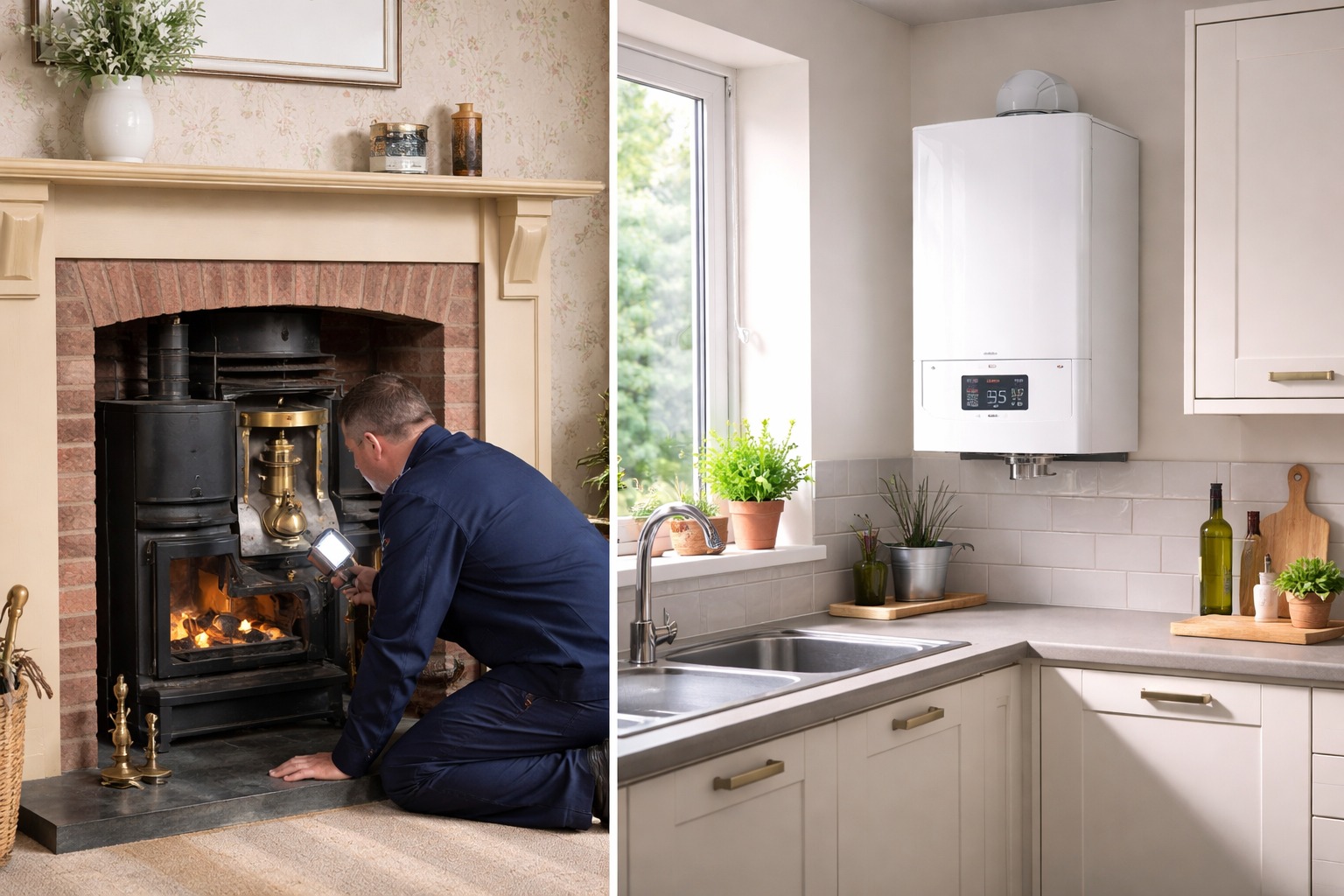
Back boilers were commonly installed in UK homes from the 1960s through to the 1980s. They were typically fitted behind a gas fire and provided both heating and hot water.
However, production of new back boilers effectively stopped in the late 1990s. As heating technology improved and efficiency standards tightened, manufacturers shifted entirely toward modern condensing boilers.
Since then, the industry has moved on completely. Today, no major manufacturer produces back boilers, and no reputable installer will recommend fitting one.
Why can’t you buy back boilers anymore?
There isn’t a single reason – they’ve simply been overtaken in every meaningful way.
The biggest factor is efficiency. Back boilers typically operate at around 55–65%, meaning a large portion of the gas you pay for is wasted. Modern condensing boilers, by comparison, achieve efficiencies of over 90%.
There are also regulatory and environmental considerations. UK building regulations now prioritise high-efficiency heating systems to reduce carbon emissions. Back boilers don’t meet these expectations.
Then there’s practicality. Modern boilers are smaller, more flexible in terms of installation location, and compatible with smart heating controls. Back boilers, hidden behind fireplaces, simply don’t fit how homes are used today.
Can you buy a second-hand or refurbished back boiler?
Technically, you might come across refurbished or second-hand back boilers—but this is rarely a good idea.
There are several reasons for this:
No warranty or manufacturer support.
Limited availability of spare parts.
Lower safety and efficiency standards.
Potential compliance issues with modern regulations.
In reality, installing a second-hand back boiler is a short-term fix at best and a risk at worst. Most engineers will advise against it.
What happens if your back boiler breaks?
This is where many homeowners find themselves caught out.
If your back boiler stops working, repair isn’t always possible. Even when it is, it can be expensive and temporary due to the difficulty of sourcing parts.
In many cases, a breakdown leads directly to replacement. That’s why many homeowners now choose to upgrade proactively rather than wait for the system to fail.
If you want a detailed breakdown of the costs involved, it’s worth reading our guide on back boiler vs modern boiler cost differences, which explains how running costs compare over time.
What are the alternatives to a back boiler?
If replacement is the only realistic option, the next question is: what should you install instead?
Most homes move to one of the following:
A combi boiler is the most popular choice. It provides heating and hot water on demand without the need for a separate cylinder or tank. It’s compact, efficient, and ideal for small to medium-sized homes.
A system boiler is better suited to larger properties or homes with multiple bathrooms. It works with a hot water cylinder, allowing for stronger flow rates when multiple taps or showers are in use.
Both options are significantly more efficient than a back boiler and are designed to meet current standards.
Is it illegal to keep a back boiler?
No – it’s not illegal to have or use an existing back boiler.
If your system is working safely, you’re allowed to continue using it. There’s no requirement to remove it purely because of its age.
However, that doesn’t mean it’s a good long-term option. Efficiency is lower, repair options are limited, and running costs are higher. Most homeowners replace them when they become unreliable or expensive to maintain.
Why most homeowners choose to replace
For many people, the decision comes down to control.
Keeping a back boiler means accepting higher running costs and the risk of unexpected breakdowns. Replacing it gives you a modern, efficient system with predictable performance and lower monthly bills.
There are also lifestyle benefits. Removing the back boiler and gas fire frees up your fireplace wall, giving you more flexibility in how you use your living space.
Modern systems also offer better heating control, faster hot water, and compatibility with smart thermostats—making day-to-day life more comfortable.
The bottom line
You can’t buy a new back boiler in the UK anymore – and in practice, replacing like-for-like isn’t a viable option.
If your current system is still running, you may be able to keep it going for now. But as parts become harder to find and costs continue to rise, replacement becomes less of a choice and more of an inevitability.
The key difference is whether you plan the upgrade on your own terms – or deal with it when the system fails.
Ready to Move On From Your Back Boiler?
If your current system is ageing or becoming unreliable, now is the time to act.
A planned back boiler replacement gives you lower energy bills, improved reliability, and a heating system designed for modern living.
We replace back boilers in Bristol, Bath and across North Somerset and provide clear, honest advice and a fully itemised quote, so you know exactly what to expect—no surprises, no pressure.
Get your free, no-obligation quote today and take the first step towards a more efficient home.