








If you’re researching back boiler replacement, you’re likely weighing up one key question: is it really worth upgrading, or can you keep your existing system running a bit longer? While back boilers were once a reliable solution for UK homes, they’re now far less efficient, more expensive to run, and increasingly difficult to repair. Understanding the real cost difference between a back boiler and a modern condensing system will help you make an informed decision – one that could save you money every year.
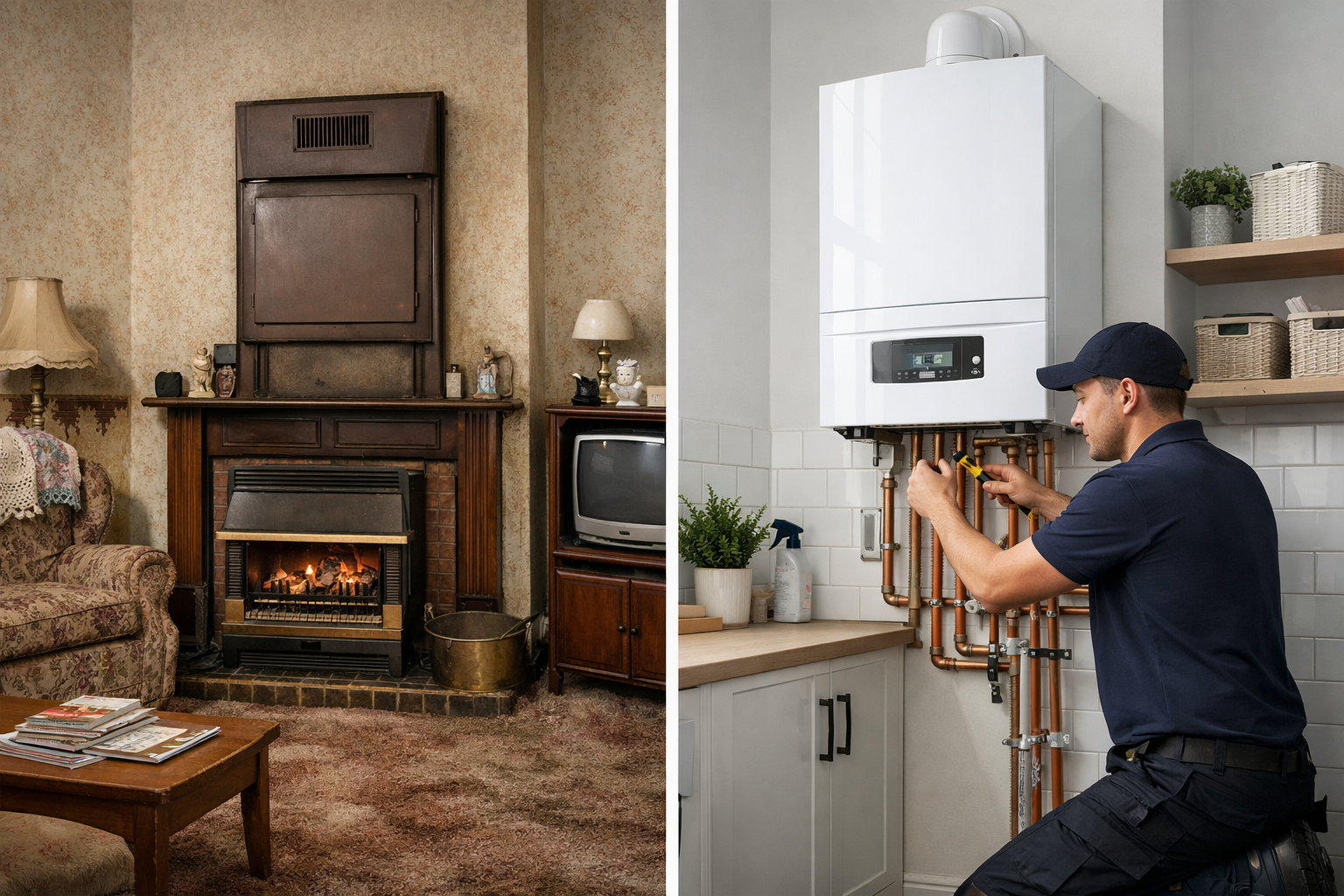
What’s the difference between a back boiler and a modern boiler?
Back boilers were widely installed in UK homes from the 1960s through to the 1980s. They sit behind a gas fire and heat both your radiators and hot water. At the time, they were compact and practical.
Modern boilers – typically condensing combi or system boilers – are far more advanced. They recover heat that would otherwise be lost, making them significantly more efficient and cheaper to run.
The key difference comes down to efficiency. Most back boilers operate at around 55–65%, while modern A-rated condensing boilers run at over 90%. That gap is where the cost difference really starts to show.
How much more does a back boiler cost to run?
An inefficient boiler doesn’t just waste energy – it wastes money every single month.
Let’s take a typical UK home. If your heating and hot water cost around £1,200 per year with a back boiler, a modern boiler operating at over 90% efficiency could reduce that by £300–£400 annually.
That’s not a one-off saving – it repeats every year. Over five years, that’s £1,500–£2,000 back in your pocket. Over ten years, the difference becomes substantial.
The hidden costs of keeping a back boiler
Running costs are only part of the picture. Older systems come with a set of hidden costs that many homeowners don’t consider until something goes wrong.
Repairs are becoming more frequent and more expensive. Back boilers haven’t been manufactured since 1998, which means parts are increasingly difficult to source. When a component fails, it’s not always a straightforward fix – and in some cases, repair simply isn’t possible.
There’s also reliability to think about. Older systems are far more prone to breakdowns, often at the worst possible time – like the middle of winter.
Upfront cost vs long-term value
It’s true that replacing a back boiler is a bigger job than a standard boiler swap. Costs typically reflect the additional work involved—removal, relocation, and installation of a modern system.
A new boiler is an investment that pays back over time through lower energy bills, reduced repair costs, and improved reliability.
When does it make sense to replace?
For most homes, replacing a back boiler makes financial sense long before it actually breaks down.
If your system is over 20–25 years old, needs regular repairs, or struggles to heat your home efficiently, replacement is usually the better option.
So, is it worth it?
In simple terms, yes. A modern boiler is significantly cheaper to run, more reliable, and better suited to how we use heating today.
If you’re still using a back boiler, the question isn’t really if you’ll replace it – it’s whether you do it on your own terms or wait until it forces your hand.
Ready to Replace Your Back Boiler?
If you’ve weighed up the costs, the next step is simple. A planned back boiler replacement gives you lower energy bills, better reliability, and a heating system that’s built for modern living.
We provide clear, honest advice and a full, itemised quote – so you know exactly what to expect from day one. No pressure, no hidden costs.
Get your free, no-obligation quote today and take control of your heating upgrade.