








Over the last few summers, we’ve had more calls from homeowners across Bristol and Bath asking about fitting air conditioning at home than ever before. Loft conversions that overheat, garden offices that are unbearable by mid-afternoon, bedrooms that never seem to cool down – it’s become a common conversation.
One of the first questions we’re asked is simple: “Do I need planning permission for this?” Understandably, people don’t want to fall foul of regulations or upset the neighbours. In this guide, I’ll walk you through how planning permission for air conditioning rules in the UK generally work, where domestic air conditioning regulations come into play and what you should consider before installing a system.
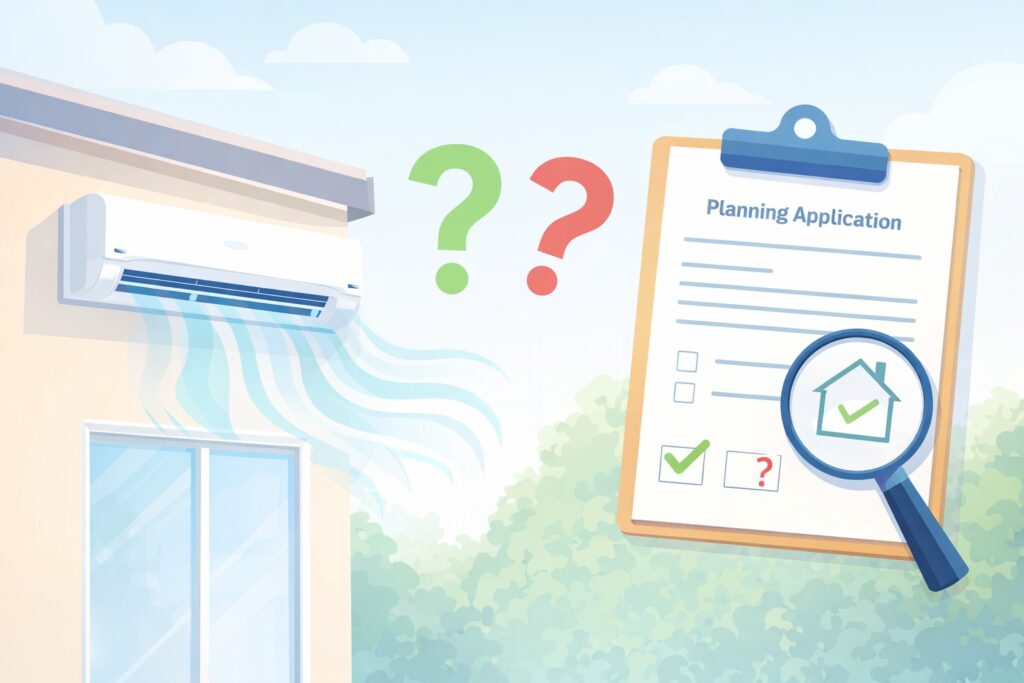
When Is Planning Permission Required?
In many standard houses, installing a single outdoor condenser unit for air conditioning falls under permitted development rights. That means you may not need formal AC planning permission approval, provided certain conditions are met.
However, there are situations where planning permission is required. These commonly include:
- Flats and maisonettes
- Listed buildings
- Homes in conservation areas
- Properties where permitted development rights have been removed
- Installations involving multiple external units
If you live in a flat in Bristol city centre or a Georgian townhouse in Bath, for example, the rules are usually tighter. We’ve worked on properties near the Royal Crescent where even minor external changes required careful checks with the local authority.
It’s always wise to confirm your specific situation with your local planning department before going ahead. The rules can differ slightly between councils.
Permitted Development Rules Explained
For most detached and semi detached homes, permitted development covers one air conditioning unit subject to certain limits.
Common Conditions
The external unit must:
- Be installed at least one metre from the property boundary
- Not be mounted on a pitched roof or a wall facing a highway in some cases
- Be used solely for air conditioning purposes
- Meet noise and size limits set out in domestic air conditioning regulations
There are also volume restrictions. The outdoor unit must not exceed a certain size, typically 0.6 cubic metres. Most modern domestic units we fit fall comfortably within that, but it’s something we check at survey stage.
If you’re unsure whether your home still benefits from permitted development rights, particularly on newer estates around the outskirts of Bristol, it’s worth checking your original planning consent. Developers sometimes remove these rights as part of the initial approval.
Noise and External Unit Placement
Noise is one of the biggest concerns for planning departments and neighbours alike. Modern air conditioning systems are far quieter than older models, but location and installation quality make a big difference.
The unit must meet specific sound level limits at the nearest neighbouring window. This is assessed using a standard calculation method under domestic air conditioning regulations. In simple terms, the system’s noise output combined with how close it is to your neighbour’s property must fall below a set threshold.
From experience, careful siting solves most issues. For example, placing a condenser on a solid wall mounted bracket away from bedroom windows and not loose on decking or thin fencing reduces vibration and sound transfer. We often recommend anti vibration mounts as standard, especially in tighter streets in Bath where properties sit close together.
It’s also good practice to speak with your neighbour before installation. A quick heads up can prevent unnecessary complaints later on.
Listed Buildings and Conservation Areas
If your property is listed or located in a conservation area, planning becomes more involved. In these cases, you are likely to need planning permission air conditioning UK approval and possibly listed building consent as well.
Bath in particular has extensive conservation zones and listed properties. External units fixed to stone façades or visible from the street will usually be scrutinised carefully. Often, we look at discreet locations such as internal courtyards, rear elevations or even alternative solutions like internal condensers where appropriate.
It’s important not to start work before approval is granted. Unauthorised alterations to listed buildings can result in enforcement action, which is far more stressful and expensive than waiting for the correct permissions in the first place.
What About Building Regulations?
Separate from AC planning permission rules in the UK, building regulations may also apply. These focus more on safety and technical standards than appearance.
Key areas include:
- Electrical compliance
- Structural integrity of wall fixings
- Proper condensate drainage
- Energy efficiency requirements
A qualified installer will ensure all electrical work is carried out safely and in line with current regulations. We always use appropriately rated circuits and isolators. It’s not uncommon in older Bristol terraces to find consumer units that need upgrading before an AC system can be safely connected.
Drainage is another detail that gets overlooked. Condensate should discharge safely without causing damp issues or dripping onto footpaths below. It may sound minor but it’s exactly the sort of thing that can lead to complaints if poorly handled.
A Practical Approach for Homeowners
If you’re considering air conditioning, here’s the sensible order to follow:
- Confirm whether your property is listed or in a conservation area
- Check whether permitted development rights apply
- Review proposed unit size and location
- Consider noise impact on neighbours
- Use a qualified installer familiar with domestic air conditioning regulations
Most homeowners in standard houses find that planning permission is not required, provided the installation is designed correctly. The key is getting proper advice before a unit is ordered or fitted.
At L & P Heating Services Ltd, we regularly advise customers on planning permission UK rules for air conditioning requirements and practical compliance. We’ll always flag up if AC planning permission is likely to be needed before any work begins. As a local company, L & P Heating Services Ltd understands the specific considerations for properties across Bristol, Bath and surrounding areas, from new build estates to period homes tucked down narrow lanes.
If you’re unsure where you stand or want a straightforward assessment of your home, get in touch with our team at L & P Heating Services Ltd in Bristol, Bath and surrounding areas. We’re happy to talk it through and make sure everything is done properly from day one. Contact for expert installation advice.