








If you rent out a property with a gas boiler, hob or fire, the gas safety certificate is the one bit of paperwork you really can’t let lapse. In England, every gas appliance, fitting and flue you provide has to be checked by a Gas Safe registered engineer every 12 months, and your tenants need a copy of the record. We do a lot of these for landlords across Bristol and Bath, and most problems come down to dates slipping at changeover. You can book your landlord gas safety certificate with us, and here’s what you need to know first.
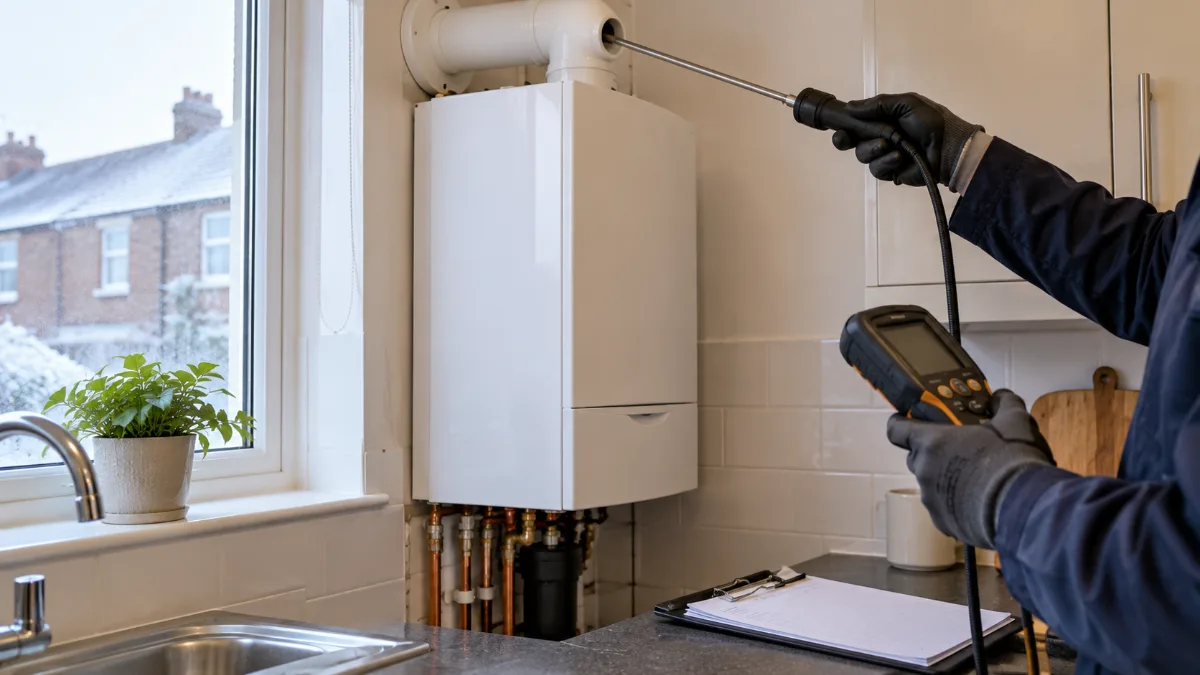
What the certificate actually is
It’s the gas safety record the engineer fills in after the annual check. Most people still call it a CP12, after the old form number, and that’s fine.
It lists every appliance we’ve looked at, what we tested and whether anything was unsafe. The legal duty comes from the Gas Safety (Installation and Use) Regulations 1998.
It covers the appliances, pipework and flues that you, as the landlord, provide. If a tenant brings their own gas cooker, that appliance isn’t your responsibility. The pipework feeding it still is.
What we check
We test the gas pipework for leaks, then go through each appliance in turn. Is it burning properly? Is the flue taking the fumes away safely? Is there enough ventilation? Do the safety devices shut the gas off when they should?
It’s usually a fairly quick visit for a flat with a combi and a hob. A house with an old gas fire, a cooker and a boiler in the loft takes a bit longer.
One thing that confuses people: a gas safety check is not a boiler service. We’re confirming the appliance is safe on the day, not stripping and cleaning it. More on that in do landlords need a boiler service every year.
The dates you need to get right
There are four to remember.
- Every appliance and flue checked at least every 12 months.
- Existing tenants given a copy within 28 days of the check.
- New tenants given a copy before they move in.
- Each record kept for at least two years.
That third one is where people come unstuck. It’s easy to remember the annual renewal and forget the paperwork at a mid-year changeover.
You can have the check done up to two months before it’s due and keep your original renewal date. Handy if your tenants are only around on certain days.
Smoke and carbon monoxide alarms
Since October 2022, landlords in England have had to fit a smoke alarm on every storey used as living space. You also need a carbon monoxide alarm in any room with a fixed combustion appliance, so a boiler, gas fire or wood burner. Gas cookers are the exception.
The alarms have to be working on day one of each new tenancy, and if a tenant reports one as faulty, you have to repair or replace it. Councils can fine up to £5,000 for breaches. We’ve written up where to fit carbon monoxide alarms and how to test them if you want the detail.
Why rented homes fail
Most of the problems we find are the same few things over and over.
Flues we can’t see. Some boilers have the flue running through a ceiling void or boxed in behind a kitchen unit. If we can’t inspect it along its length, we can’t call it safe, and the boiler may have to be turned off until inspection hatches go in. This one surprises a lot of landlords.
Blocked vents. Tenants block air vents to stop draughts, or a wardrobe ends up pushed against one. Older gas fires and some cupboard boilers need that air to burn safely.
Old gas fires. If there’s a gas fire that’s been sitting there since the 80s and nobody’s looked at it in years, there’s a decent chance it’ll fail on combustion or spillage.
Alarms. Taken down because they kept going off, flat batteries, or well past their expiry date.
If something is immediately dangerous, we’ll disconnect it and label it, with permission. If it’s at risk, we’ll turn it off, again with permission, and tell you what the repair is. Either way you’ll know exactly where you stand.
Landlords in Bristol and Bath
Both cities have a lot of student lets. Redland, Cotham and Bishopston in Bristol and Oldfield Park in Bath are full of them, and most of those tenancies turn over in the summer.
Book in spring and you’ll miss the rush. If you’ve got several properties, it’s worth lining up the renewal dates so they all come round together. And if you run a licensed HMO, the council can ask to see a current gas safety record at any time.
What happens if you don’t have one
Not having a valid check is a criminal offence. The Health and Safety Executive can prosecute, which can mean an unlimited fine or prison, and your insurer may not want to know either.
But the real reason is carbon monoxide. Your tenants can’t see it or smell it.
We’re Gas Safe registered, number 229864. You or your tenants can check that, and any engineer’s ID card, on the Gas Safe Register website before letting anyone in.
Frequently asked questions
Do I need a certificate if there’s no gas in the property?
No. The gas rules only apply where there’s a gas supply or gas appliances. You’ll still need an electrical safety report, the EICR, at least every five years under the separate rules for private landlords in England, and the smoke alarm rules still apply.
What if my tenant won’t let the engineer in?
You have to take all reasonable steps. Write to them explaining why you need access, offer a few different dates and keep a copy of every letter, email and text. If they still refuse, that record shows you did everything you could to comply.
Does the gas safety check cover the boiler service?
No. The check tells you the appliances are safe. It doesn’t include the cleaning and maintenance that keep a boiler reliable and its guarantee valid. Plenty of our landlords book a boiler service at the same visit to save us coming out twice.
Do I need a new certificate every time the tenants change?
Not if the current one is still in date. Just give the new tenants a copy before they move in. Some landlords like a fresh check at changeover anyway, especially if the place has been empty for a while or there’s been work done.
Book your gas safety check
Call us on 01275 400 687 or drop us a message with the address and your renewal date, and we’ll sort a time that works for you and your tenants.