








Boilers rarely just stop. Most of the time they’ll start making a new noise, losing pressure or throwing up a fault code first, and those early signs are your chance to get it sorted before you lose your heating altogether. Some of these problems you can safely check yourself in a few minutes. Others need a Gas Safe engineer, and it’s important to know which is which. We fix boilers across Bristol and Bath every day, and if yours is playing up, our boiler repairs team can help. Here are the problems we see most and what they usually mean.
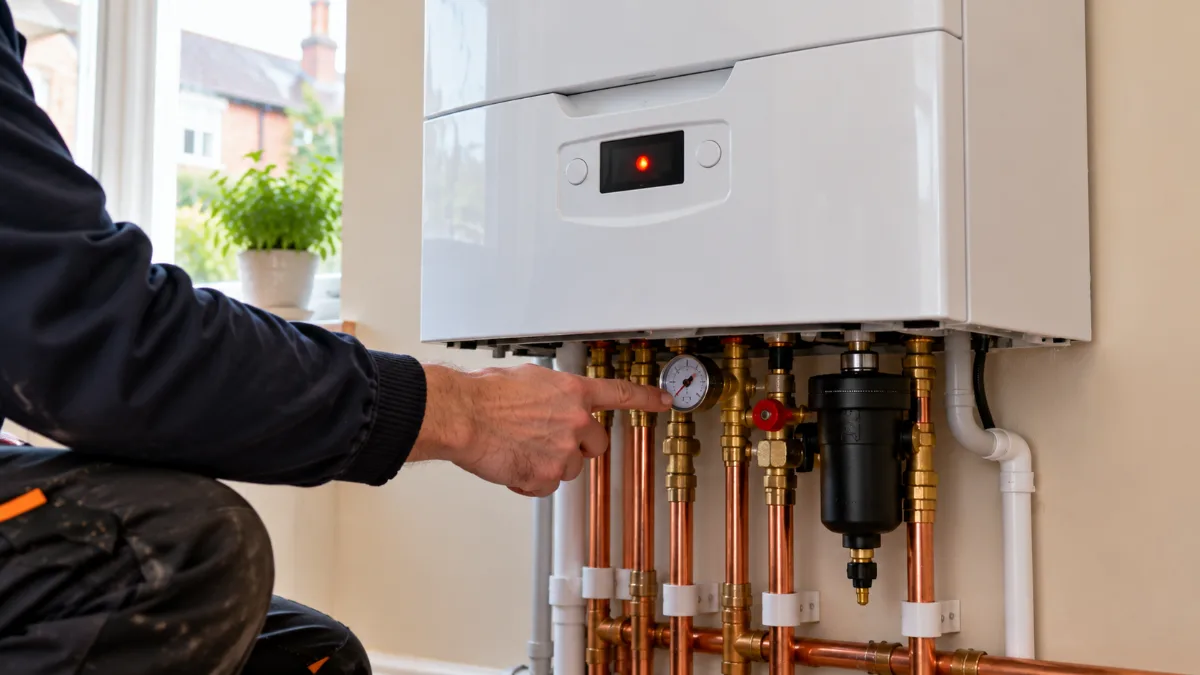
A noisy boiler
Kettling
A rumbling or popping sound, like a kettle coming to the boil. It’s usually limescale or sludge building up on the heat exchanger, so water overheats in hot spots and boils. The water round here is hard, so we see it a lot. It won’t fix itself, and it puts strain on the boiler.
Banging or knocking
Often the same cause as kettling. It can also be pipes expanding and knocking against joists, or a pump that’s struggling.
Gurgling
Normally air in the system. Bleeding radiators often helps. If it keeps coming back, air is getting in somewhere.
Whistling or high-pitched noise
Can mean low water flow, a partly blocked heat exchanger or a pump problem.
Humming or droning
Often the pump. Sometimes it’s just set too high, sometimes it’s on its way out.
A little noise when the boiler fires up is normal. A new noise, or one that’s getting louder, is worth getting looked at.
Low pressure
The pressure gauge has dropped below 1 bar and the boiler’s locked out. You can usually top it back up yourself with the filling loop. If it keeps happening, there’s a leak somewhere. Our guide to low boiler pressure goes through it step by step.
The boiler keeps turning on and off
Short cycling is when the boiler fires, runs for a minute and shuts off, over and over. It can be a boiler that’s too big for the house, a thermostat in the wrong place or a fault with the boiler itself. We’ve written about short cycling in more detail.
A frozen condensate pipe
In a cold snap, this is the most common callout we get. The plastic pipe that takes condensate from the boiler to a drain freezes outside, the boiler backs up and locks out. You’ll often hear a gurgling sound from the boiler first. Pouring warm, not boiling, water over the frozen section of pipe outside usually thaws it, then reset the boiler.
A fault code on the display
Most modern boilers will show a code when something’s wrong. Your manual will tell you what it means. Some, like low pressure, you can sort yourself. Others, like an ignition fault or a flame failure, need an engineer. If you’ve got a Worcester Bosch, see our guide to common Worcester Bosch faults.
What you can safely check yourself
Before you call anyone, it’s worth checking:
- the pressure gauge, and topping up if it’s low
- the thermostat and timer settings, and the batteries in a wireless thermostat
- the fused spur next to the boiler is switched on
- your gas supply, if you’ve got a prepayment meter or other gas appliances
- the condensate pipe, if it’s freezing outside
You can also reset the boiler once or twice. If it won’t stay on after that, stop and call an engineer.
What you must leave to an engineer
Never take the cover off a gas boiler. Anything inside the casing, the gas valve, the burner, the flue or the gas pipework is for a Gas Safe registered engineer only. The same goes for oil boilers and OFTEC engineers.
If you smell gas, turn off the gas at the meter if it’s safe to, open the windows, don’t use switches or naked flames, and call the National Gas Emergency Service on 0800 111 999. We’ve written about what to do if you smell gas.
If your carbon monoxide alarm goes off, open the windows, get everyone outside and call the emergency number.
Why it doesn’t pay to wait
A small problem left alone usually turns into a bigger one. A weeping valve becomes a damaged ceiling. A noisy, kettling boiler eventually cracks a heat exchanger. Low pressure topped up week after week pulls fresh oxygen into the system and speeds up corrosion.
There’s also the timing. Faults that start in autumn tend to finish the job when the boiler’s working hardest in midwinter, which is exactly when everyone else’s breaks down too.
Boiler problems in Bristol and Bath homes
Hard water is the big local factor. Limescale builds up fast in combis, especially if there’s no scale reducer fitted, and it’s behind a lot of the kettling and lukewarm showers we see.
Older houses bring their own issues: long pipe runs, old radiators full of sludge and condensate pipes running across cold outside walls.
Frequently asked questions
Is a noisy boiler dangerous?
Usually not on its own, but it’s a sign something isn’t right, so don’t ignore it. If the noise comes with a smell of gas, a yellow or orange flame, sooty marks around the boiler or your carbon monoxide alarm going off, switch the boiler off and call for help straight away.
How many times can I reset my boiler?
Once or twice is fine. If it locks out again straight away, resetting it again and again won’t fix the problem and can make some faults worse. Note down any fault code on the display and give an engineer a call.
Can I fix my boiler myself?
Only the outside checks, like topping up the pressure, bleeding radiators, checking the thermostat and thawing a frozen condensate pipe. Anything inside the boiler or involving gas is a legal job for a Gas Safe registered engineer. It isn’t worth the risk.
Boiler playing up?
Ring us on 01275 400 687 or send us a message and we’ll get one of our Gas Safe engineers out to you.