








When you’re redoing a kitchen or planning an extension, the boiler is often the thing in the way. The good news is that a modern room-sealed boiler can go in most rooms of the house: kitchens, utility rooms, airing cupboards, lofts, garages and even bathrooms if it’s outside the wet zones. The flue, the condensate pipe and access for servicing are what really decide where it can go. We move and fit boilers across Bristol and Bath, so here’s what the rules say and what works in practice. If you’re planning a new boiler, see our gas boiler installations page.
Room-sealed boilers changed everything
Older open-flued boilers took the air they burned from the room they were in. That’s why there were so many rules about putting them in bedrooms and bathrooms.
Almost every boiler fitted now is room-sealed. It draws its air in from outside through the flue and sends the fumes back out the same way. The room itself plays no part. That opens up far more places to put one.
Where boilers commonly go
The kitchen
Still the most common spot. Gas and water are usually nearby, there’s an outside wall for the flue and a drain for the condensate. It’s easy and it’s cheap.
Airing cupboards and utility rooms
Great if you want it out of sight. Make sure there’s enough space around it for an engineer to work. Manufacturers give minimum clearances for servicing, and squeezing a boiler into a cupboard that’s too tight can cause problems down the line.
The loft
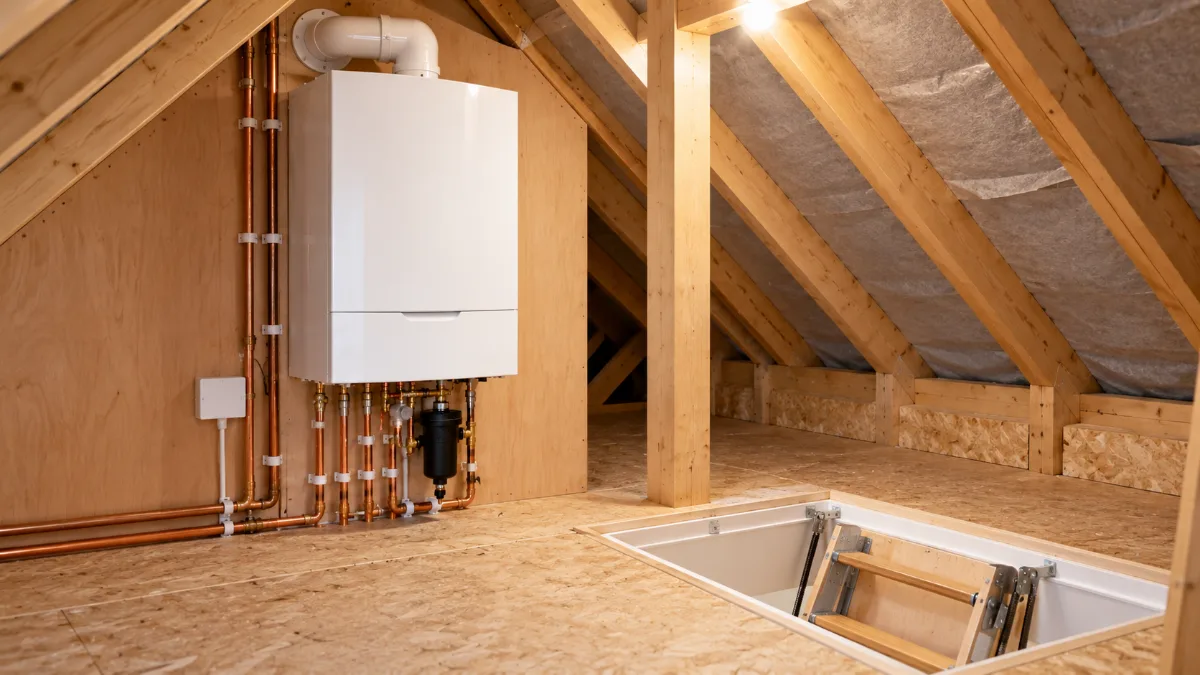
Popular because it frees up space downstairs. It can work well, but it needs a few things. A fixed loft ladder, a light, and a boarded walkway to the boiler, so an engineer can safely get to it.
The condensate pipe and any pipework up there need protecting from frost. And with a combi in the loft, remember you’ll have to climb up there to top up the pressure or reset it.
Bathrooms
Yes, a boiler can go in a bathroom. The rules are about the electrical zones around the bath and shower. Keep it out of the zones closest to the water, and check the boiler is rated for the zone it’s in.
Bedrooms
A room-sealed boiler can go in a bedroom. Many people still prefer not to, mainly because of the noise when it fires up at night. And fit a carbon monoxide alarm in the room.
Garages
Fine, as long as the boiler’s protected from frost and knocks from the car, and the condensate pipe can’t freeze. An unheated garage is the classic place for a frozen condensate pipe.
The flue is usually the deciding factor
Where the boiler goes is mostly about where the flue can come out. The flue terminal has to be set distances away from windows, doors, airbricks, corners, gutters and boundaries. Those distances come from the manufacturer’s instructions and the Building Regulations.
Get it close to a neighbour’s window or a path and you might need a plume kit to direct the steam away. If the flue runs through a ceiling void or boxing, it has to be accessible through inspection hatches so it can be checked along its length. That one catches a lot of people out.
Condensate needs a route to a drain
Every condensing boiler produces condensate, slightly acidic water that has to go to a drain. Ideally it runs inside the house to a waste pipe. If it runs outside, it needs to be the right size and properly insulated, or it’ll freeze in a cold snap and lock the boiler out.
Boiler placement in Bristol and Bath homes
In a lot of Bristol terraces, the boiler’s on the back kitchen wall, and that’s where it makes most sense. In flats, the options can be limited by where a flue can go without ending up next to someone else’s window.
Bath brings its own challenges. Many homes are listed, or in a conservation area, and you can’t always put a flue on the front of a Georgian building. Sometimes the answer is a vertical flue through the roof, sometimes a back elevation. Always check with the council before changes to the outside of a listed building.
Frequently asked questions
Can I move my boiler to the loft?
Usually, yes. It needs a fixed ladder, lighting and a boarded walkway, plus a flue route through the roof or a gable wall and somewhere for the condensate to go. It’s a bigger job than a straight swap, so it typically takes two to three days. We’ll check everything at the survey before quoting.
Can a boiler go in a cupboard?
Yes, as long as there’s enough room around it for servicing and repairs. Each manufacturer gives minimum clearances. If a cupboard is built around a boiler later, it still needs those clearances and, if there’s a flue in the cupboard, access to inspect it.
Do I need permission to move my boiler?
You don’t usually need planning permission. The work has to meet Building Regulations, though. A Gas Safe registered installer can notify Building Control for you. If you live in a listed building, speak to the council before changing where the flue comes out.
Want to move your boiler?
Ring us on 01275 400 687 or send us a message. We’ll come and have a look, tell you where it can go and give you a fixed price for the job.