







Air conditioning usually tells you when something’s wrong. It just isn’t always obvious what it’s trying to say. Warm air from a unit that’s meant to be cooling, water dripping down the wall, a new rattle or a smell when it starts up. Some of those are a dirty filter you can clean yourself. Others need an F-gas engineer. We look after systems across Bristol and Bath, and if yours has stopped working, our air conditioning team can help. Here are the signs to watch for and what to do about each.
1. It’s not cooling or heating properly
The unit’s running, but the room isn’t getting cooler, or it takes far longer than it used to.
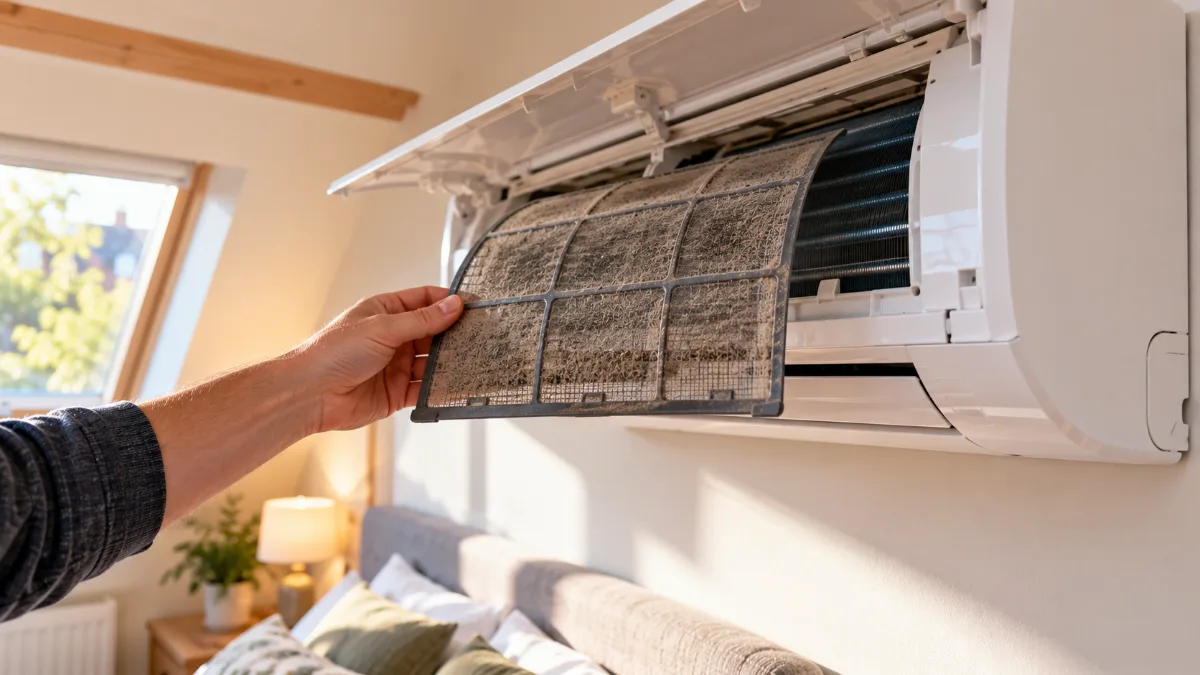
Start with the easy bits. Check it’s in the right mode and the temperature’s set below the room temperature. Then take the filters out and look at them. A clogged filter is the most common cause by a mile.
If the filters are clean and it’s still struggling, it could be low refrigerant, which means a leak, or a problem with the outdoor unit. Both need an engineer.
2. Water leaking from the indoor unit
When it’s cooling, the unit pulls moisture out of the air and sends it out through a drain pipe. If that drain gets blocked with dust or slime, water backs up and drips out of the front of the unit or down the wall.
Switch it off and call us. A blocked drain is usually a quick fix, but left alone it can damage walls, ceilings and the unit’s electrics.
Ice on the pipes or the indoor coil is a different problem. It usually means low airflow from dirty filters or low refrigerant.
3. Strange noises
The indoor unit should be very quiet. A bit of hum from the outdoor unit is normal.
Rattling can be a loose panel or something caught in the fan. Grinding or squealing points to the fan motor or bearings. A hissing or bubbling sound can mean a refrigerant leak.
Any new noise is worth getting looked at before it turns into a bigger repair.
4. A bad smell
A musty or damp smell when it starts up usually means mould or bacteria in the filters, coil or drain tray. A proper clean normally sorts it.
A burning smell is different. Switch the unit off at the isolator straight away and don’t use it again until an engineer has checked it. It can mean an electrical fault.
5. It keeps switching on and off
Short bursts of running, then off, then on again. It can be a thermostat problem, a unit that’s too big for the room, dirty filters or an electrical fault. It wastes energy and wears the compressor, so it’s worth getting checked.
6. Your bills have crept up
If you’re running it the same as last year but paying more for electricity, the unit may be working harder than it should. Dirty filters, a dirty outdoor coil or low refrigerant are the usual causes. A service often brings the efficiency back.
What to do if it breaks down completely
If the unit won’t come on at all:
- check the remote batteries
- check the isolator switch next to the outdoor unit and your fuse box
- look for an error code on the indoor unit’s display and note it down
- switch it off for a few minutes, then try again
If none of that works, call us with the error code and the make and model.
Don’t open the outdoor unit, and never try to top up refrigerant yourself. It’s illegal without F-gas certification, and if there’s a leak it’ll just escape again.
Repair or replace?
Most faults on a reasonably modern unit are worth repairing. Filters, drains, fan motors, sensors and even refrigerant leaks can usually be fixed.
Replacement starts to make more sense if the unit is getting old and needs a big repair, if parts are no longer available, or if it’s an older system using a refrigerant that’s being phased down and is expensive to get hold of. Newer units are also much more efficient.
Air conditioning repairs in Bristol and Bath
Most of the breakdowns we see come down to the same thing: no servicing. Filters left for years, drains blocked with slime and outdoor units choked with leaves and cobwebs. A yearly service catches nearly all of it. See our guide to air conditioning maintenance.
Frequently asked questions
How long does an air conditioning unit last?
A well-maintained split system will usually give you many years of service, and plenty last well over a decade. Ones that are never serviced tend to fail sooner. Keeping the filters clean and having it checked once a year makes the biggest difference.
Can I regas my air conditioning?
Not yourself. Handling refrigerant legally needs F-gas certification. And if the system’s low on refrigerant, there’s a leak somewhere, because refrigerant doesn’t get used up. An engineer needs to find and fix the leak before regassing, or it’ll just happen again.
Is a leaking air conditioner dangerous?
A water leak isn’t dangerous in itself, but it can damage walls and get into the electrics, so switch it off and get it seen. A refrigerant leak should be dealt with by an F-gas engineer. If you ever smell burning, switch the unit off at the isolator straight away.
Air conditioning playing up?
Ring us on 01275 400 687 or send us a message with the make, model and any error code, and we’ll get it sorted.