








Living in a Georgian or Victorian house is lovely, right up until the heating goes off on a cold night. Older homes are harder on boilers. Long pipe runs, old pipework, basements and lofts, systems that have been added to for decades. They all make breakdowns more likely and annual servicing more important. We look after a lot of period properties in Bath and across Bristol, and the same problems come up again and again. If you’re in Bath, our boiler servicing in Bath page has the details, and here’s what to watch for.
Why older homes are harder on boilers
It’s rarely the boiler’s fault. It’s what it’s been connected to.
In many period houses, the heating system has been modernised in stages. A newer boiler’s been bolted onto pipework that might be 40 or 50 years old, with radiators from three different decades. Some of that pipework will be full of sludge, and some of the radiators will be too small for big rooms with high ceilings.
The boiler has to work harder to push heat round a system like that, and it gets less help from the house. Thick stone walls, single-glazed sash windows and draughty floorboards all let heat escape.
The breakdowns we see most
Sludge
Old systems collect black sludge, a mix of rust and debris from inside the radiators and pipes. It settles in the bottom of radiators, clogs the boiler’s heat exchanger and can block the pump. The tell-tale sign is radiators that are warm at the top and cold at the bottom.
Limescale
The water round Bath and Bristol is hard. In a combi, limescale builds up in the part that heats your hot water, and over time you get lukewarm showers, a boiler that bangs or “kettles”, and eventually a breakdown.
Frozen condensate pipes
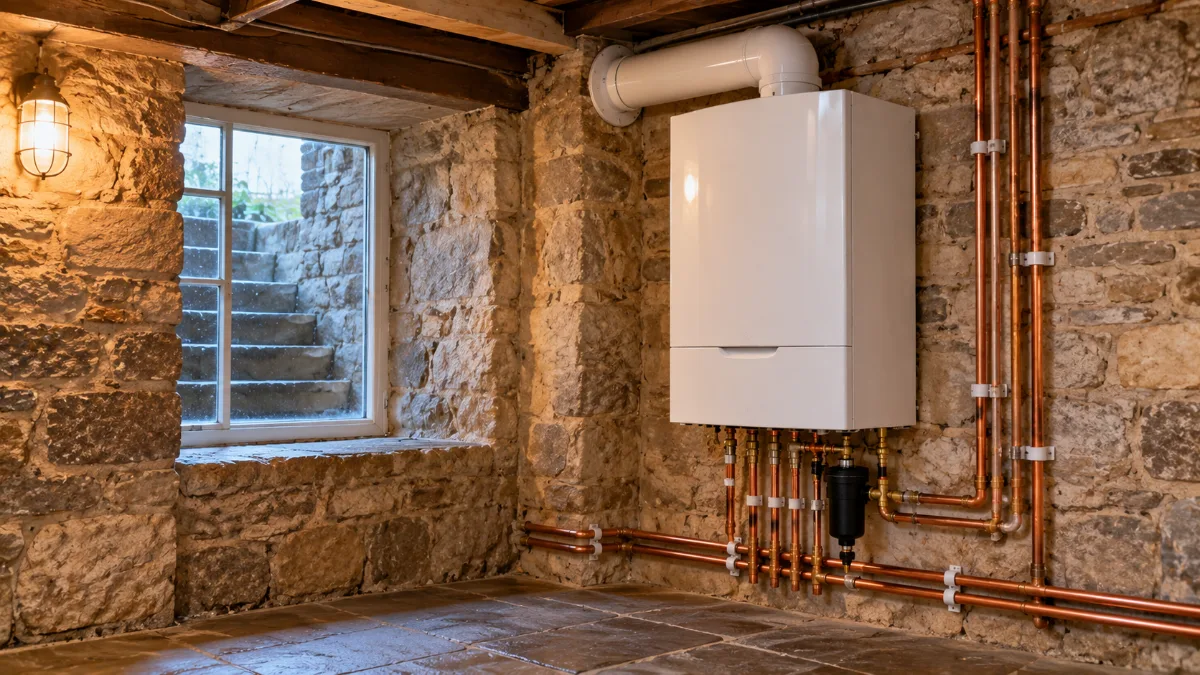
Boilers in basements, cellars and outbuildings often have long condensate pipes running outside. In a cold snap, they freeze and the boiler locks out.
Low pressure
More pipe joints and older valves mean more places for slow leaks. A system that keeps losing pressure is very common in older houses. See our guide to low boiler pressure for what to look for.
Old open-vent systems
Many older homes still have a regular boiler with tanks in the loft. Those tanks can be decades old, and a sticking ball valve or a corroded tank causes all sorts of trouble.
What a service looks for in an older house
A boiler service is the same job whatever the age of the house, but in a period home we pay extra attention to a few things.
We look at the condition of the system water for signs of sludge. We check the flue carefully, especially where it runs through old walls, chimneys or roof voids. We look for slow leaks around older valves and pipework, and we make sure condensate pipes are protected from frost.
We’ll also tell you honestly if the boiler is struggling because of the system. Sometimes a powerflush or a magnetic filter does more for your heating than a new boiler would.
Listed buildings and conservation areas
A big part of central Bath is listed, and much of the rest sits in a conservation area. That doesn’t stop you having a modern boiler, but it does affect where the flue can go.
Flues on the front of a Georgian building usually aren’t an option. A vertical flue through the roof, or an exit on the rear elevation, often is. If you’re replacing a boiler in a listed building, check with the council before any changes to the outside.
Simple things you can do
Bleed radiators that are cold at the top. Keep an eye on the pressure gauge. Lag any condensate pipe that runs outside. Keep your loft tank lid on to stop debris getting in.
And book your service before the weather turns. Older systems are far more likely to give up in the first cold week of the year than any other time.
Bath and Bristol period homes
Bath’s terraces and crescents are the obvious example, but we see the same problems in Victorian villas in Clifton, Redland and Cotham, and in old stone cottages in the villages around both cities. If we’re working on a boiler in Bath and something needs fixing, we can usually sort it on the spot or come back quickly. Our boiler repairs in Bath page has more.
Frequently asked questions
How often should a boiler in an older house be serviced?
Once a year, the same as any other home. What makes the difference is not skipping it. In an older house, small problems like a weeping valve or a partly blocked condensate trap are more likely, and an annual service catches them before they turn into a breakdown.
Is a powerflush worth it in an old house?
It can be, if your system has a lot of sludge. Radiators cold at the bottom, a noisy boiler and slow heat-up times are all signs. But old pipework can be fragile, so we’ll look at the condition of the system first and tell you honestly whether a flush will help.
Can I fit a combi in a big period house?
Sometimes, but it isn’t always the best choice. A big house with more than one bathroom, or one where people use hot water at the same time, often does better with a system boiler and cylinder. We’ll look at your water pressure and how you use your hot water before recommending one.
Book a service for your period home
Ring us on 01275 400 687 or send us a message and we’ll find a slot to suit you.