







You’ve gone to run a bath, the water’s cold, and the boiler’s sitting there with a fault light on and the pressure needle down near zero. It’s one of the most common calls we get from homes around Bristol and Bath once the heating goes back on in autumn. Often you can sort it yourself in five minutes with the filling loop. If the pressure keeps dropping, though, water is getting out somewhere, and that’s when you need our boiler repair engineers to track it down.
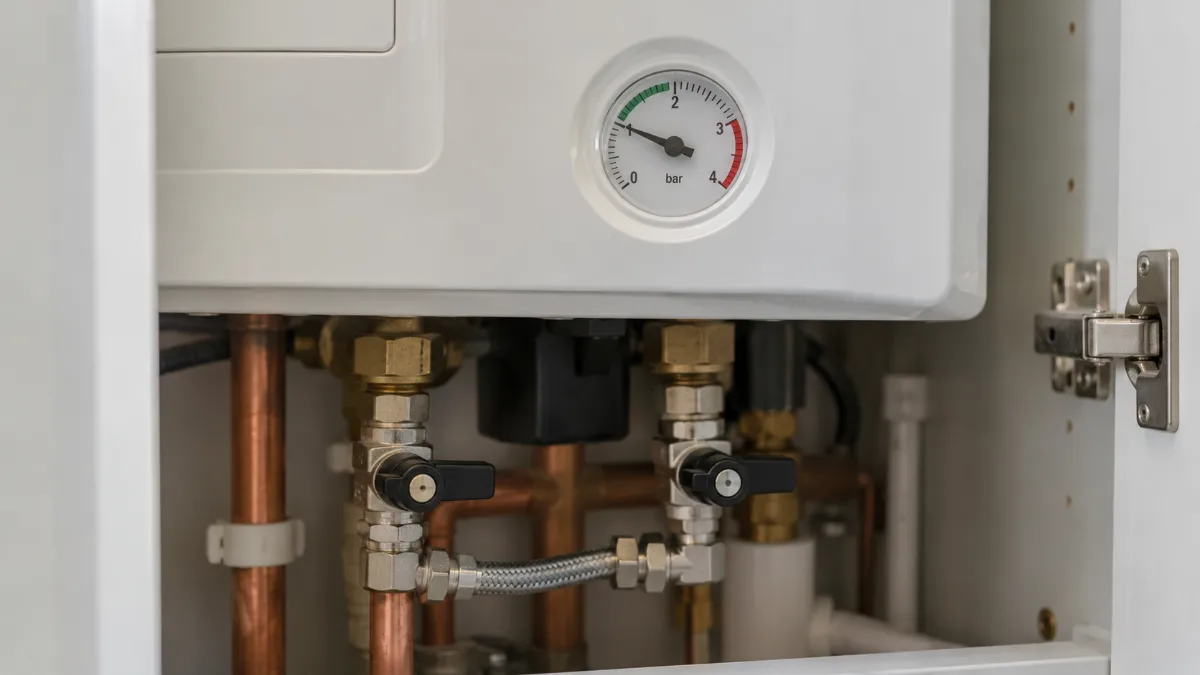
What should the pressure gauge read?
On most combi and system boilers you’re looking for somewhere around 1 to 1.5 bar with the heating off. It’ll creep up a bit once everything’s hot. That’s normal.
Drop much below 1 bar and plenty of boilers will lock out to protect themselves, which is why you lose heating and hot water at the same time. Your manual will give the exact figure for your model.
If you’ve got a regular boiler with a tank up in the loft, you probably won’t even have a gauge. Those systems top themselves up from the tank, so this isn’t your problem.
Why boiler pressure drops
A sealed system is a closed loop of water. If the pressure falls, water has got out or the system can’t hold its pressure properly. Those are really the only two options, and these are the usual reasons behind them.
You’ve just bled the radiators
Every time you let air out of a radiator, a bit of water comes with it. Bleed three or four and the gauge will have dropped. Top it back up and you’re done. Our guide to bleeding and balancing cold radiators walks you through it.
There’s a leak somewhere
This is the big one when the pressure keeps going down. Check around radiator valves, under the boiler, along any pipes you can see, and on the ceilings under upstairs radiators. A weeping valve might only leave a crusty green or white mark rather than an actual drip.
The awkward ones are under the floor. You can lose pressure for weeks from a pinhole in a pipe under the boards before a stain shows up downstairs.
Water’s coming from the boiler
If it’s dripping from inside the casing, leave the cover on. It’ll be a seal, a valve or a corroded joint, and none of those are DIY jobs. If water is anywhere near the electrics, switch the boiler off at the fused spur and give us a ring.
The pressure relief valve is letting go
Follow the copper pipe that runs from the bottom of the boiler to an outside wall. That’s the discharge pipe from the pressure relief valve. If it’s dripping, or there’s a wet patch under it, the valve is either worn out or doing its job because the pressure’s going too high when the heating runs.
The expansion vessel has lost its charge
This catches a lot of people out. Hot water takes up more room than cold, and the expansion vessel is there to soak up that extra volume. Once it loses its air charge, the pressure shoots up when the heating comes on, the relief valve dumps water to cope, and when everything cools down you’re left with too little.
So if your gauge swings from nearly 3 bar when hot to under 1 bar when cold, that’s almost always the vessel. Recharging or replacing it is an engineer’s job.
How to top your boiler pressure back up
Most combi and system boilers have a filling loop underneath. It’s either a silver braided hose with a tap at each end or, on some newer boilers, a built-in key or lever. Every make is a bit different, so have the manual handy.
- Turn the boiler off and let it cool.
- Check the filling loop is connected at both ends.
- Open the taps slowly and watch the needle.
- Close them when you reach the figure in your manual, usually 1 to 1.5 bar.
- Switch back on and press reset if it’s still showing a fault.
Make sure both taps are shut tight afterwards. One left slightly open will keep feeding water in and you’ll end up with the opposite problem.
If the filling loop is inside the casing, or you can’t find it at all, leave it to us. Don’t start taking panels off.
When to stop topping up and call an engineer
Topping up once after bleeding radiators is fine. Doing it every week isn’t. Fresh water brings fresh oxygen into the system, and that speeds up corrosion in your radiators and the boiler itself. You’re just hiding the leak.
Give us a call if the pressure’s dropped again within a few days, you can see water coming from the boiler or the outside pipe, the gauge goes into the red when the heating’s on, or the boiler won’t reset even with the pressure back up.
Pressure problems in older Bristol and Bath houses
A lot of houses round here have heating that’s been added to over the decades. A radiator for the extension, another for the loft conversion, pipes running under suspended timber floors in Victorian terraces. More joints, more places to leak, and most of them out of sight.
If you can’t find the cause, we can. We also cover boiler repairs in Bath and the villages around it.
Frequently asked questions
Is low boiler pressure dangerous?
Not on its own. The boiler shutting down on low pressure is a safety feature working properly. The risk is from what’s causing it, like a leak soaking a ceiling or getting into electrics. Smelling gas is a different matter altogether: call the National Gas Emergency Service on 0800 111 999 straight away.
Why does my pressure go up when the heating’s on?
A small rise is normal because water expands as it heats. A big jump, into the red or close to 3 bar, usually means the expansion vessel needs recharging or the filling loop hasn’t been closed properly. Check the taps first. If they’re shut, it’ll need an engineer to look at the vessel.
How often should I have to top my boiler up?
Ideally never, apart from after bleeding radiators. A healthy sealed system holds its pressure for months on end. If you’re reaching for the filling loop every week or two, there’s water escaping somewhere and it’s worth getting it found before it does any damage.
Will a boiler service pick this up?
It should. At an annual boiler service the engineer checks the expansion vessel, the relief valve and the boiler itself for any signs of leaks or corrosion. Sorting a tired expansion vessel in September is a lot better than the boiler locking out in January.
Still losing pressure?
If you’ve topped it up and the needle’s on its way down again, ring us on 01275 400 687 or send us a message. One of our Gas Safe registered engineers will come out and find out where the water’s going.