







You put the heating on for the first proper cold evening of the year, and the lounge is toasty while the back bedroom stays chilly. It happens in homes all over Bristol and Bath every autumn. Most of the time it’s an easy fix: bleed the radiators that are cold at the top, then balance the system so the heat gets shared out evenly. If they’re cold at the bottom, or still cold after all that, there’s probably sludge in the system, and that’s when our heating repair engineers can help.
First, work out what kind of cold it is
Before you reach for the radiator key, put the heating on for 20 minutes and carefully feel each radiator. The pattern tells you a lot.
Cold at the top, warm at the bottom. That’s trapped air. Bleeding will sort it.
Cold at the bottom, warm at the top. Usually sludge, a build-up of rust and muck that’s settled in the bottom of the radiator.
Cold all over, while the others are hot. Could be a stuck valve or a system that needs balancing.
Every radiator cold. It’s not the radiators. It’s the boiler, the pump or the controls. Our guide to no heating or hot water is the place to start.
How to bleed a radiator
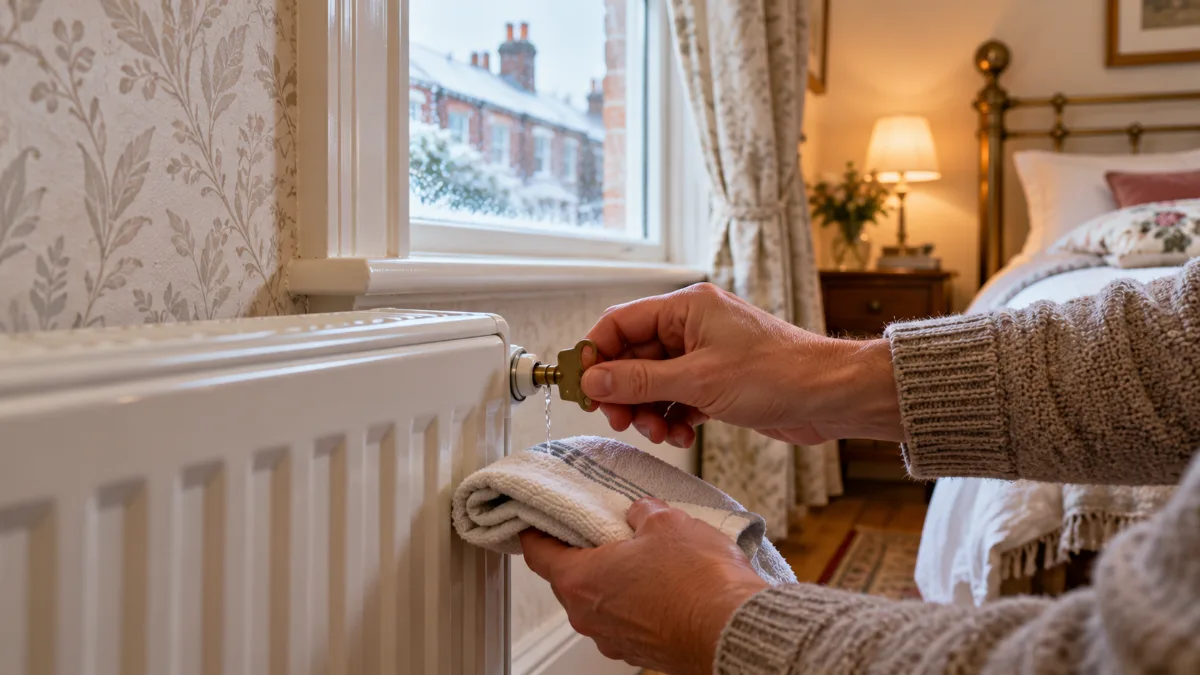
You’ll need a radiator key from any hardware shop, and an old cloth.
- Turn the heating off and let the radiators cool. The water inside can scald.
- Find the bleed valve, a small square fitting at one of the top corners.
- Hold the cloth under it and turn the key anticlockwise, about a quarter turn.
- You’ll hear a hiss as the air escapes. As soon as water starts to come out, close it.
- Do the same on any other radiators that were cold at the top.
Then check the boiler pressure. Letting air out lets a bit of water out too, so on a combi or system boiler the gauge will have dropped. If it’s below what your manual recommends, top it up with the filling loop.
How to balance your radiators
Balancing means adjusting each radiator so the hot water gets shared out fairly. Without it, the ones nearest the boiler grab all the heat and the furthest ones get the leftovers.
It takes a bit of patience, but there’s nothing to it.
Open everything up
With the heating off and cool, turn all the thermostatic valves fully open. Pull the plastic cap off the lockshield valve at the other end of each radiator and open that fully too, with a spanner or the cap itself.
See which ones heat first
Put the heating on and walk round the house noting which radiators warm up first. They’ll usually be the ones nearest the boiler.
Turn down the quick ones
Close the lockshield on the first radiator to heat up, then open it about a quarter of a turn. Move on to the next one and open it a bit more than the last. Carry on through the list. The furthest radiator might need its lockshield fully open.
It can take an evening of fiddling, but you’ll end up with a house that warms up evenly.
When it’s sludge, not air
Radiators that are cold at the bottom, or that never get properly hot after bleeding, are usually full of sludge. It’s black, it’s heavy and it settles where the water flows slowest.
Sludge doesn’t just affect the radiators. It gets pulled round the system, clogs the boiler’s heat exchanger and can block the pump. A boiler that’s kettling or banging is often struggling with it.
What’s a powerflush?
A powerflush pushes water and cleaning chemicals through the whole system at high flow to shift the sludge out of the radiators and pipework. It’s often the fix when several radiators are cold at the bottom.
Afterwards, a magnetic filter on the pipe into the boiler catches anything left behind before it can build up again. We fit one on every new boiler for exactly this reason.
Is a powerflush always the answer?
Not always. On very old pipework, a powerflush can expose weak joints that were being held together by the sludge. If one radiator is badly blocked, taking it off the wall and flushing it out in the garden can be the better option. We’ll look at your system and tell you what makes sense.
Older Bristol and Bath homes and cold radiators
Lots of homes round here have heating that’s been extended over the years. A radiator for the kitchen extension, one for the loft conversion, with long pipe runs and a mix of sizes. That makes balancing more important.
Older systems are also more likely to be carrying sludge, and no amount of bleeding will shift that.
Frequently asked questions
How often should I bleed my radiators?
There’s no fixed rule. Check them at the start of the heating season and bleed any that are cold at the top. If one needs bleeding every few weeks, air is getting into the system somehow, and it’s worth having an engineer find out why rather than bleeding it over and over.
Why is my radiator still cold after bleeding?
If water came out of the bleed valve and the radiator’s still cold, air wasn’t the problem. Cold at the bottom usually means sludge. Cold all over might be a stuck valve pin or a system that needs balancing. An engineer can check the valves and the condition of the system water.
Do I need to turn the heating off to bleed radiators?
Yes. Turning it off stops more air being drawn in while the valve’s open and lets the radiators cool, so you won’t get scalded. Wait till they’re cool to the touch, bleed them, then put the heating back on and check the pressure.
Will a powerflush make my boiler more efficient?
If your system is full of sludge, it can make a real difference. Clean water moves heat around more easily, the boiler doesn’t have to work as hard and radiators heat up faster. On a system that’s already clean, it won’t do much, so it’s worth getting it checked first.
Radiators still not warming up?
If you’ve bled and balanced and some rooms are still cold, give us a call on 01275 400 687 or drop us a message and we’ll find out what’s stopping the heat getting through.