








If you live out past the edge of the gas network, there’s a good chance there’s an oil tank at the bottom of your garden and a boiler that sounds like a small jet engine when it fires up. Oil boilers are simple machines once you know what’s going on inside, and a well-looked-after one will give you years of service. We fit and look after them across Bristol, Bath and the North Somerset villages, so here’s how they work, how long they tend to last and what you can do to get the most out of yours. If yours is getting tired, have a look at our oil boiler installations.
From the tank to the radiators
It starts at the tank. Most homes run on kerosene, sometimes called 28-second oil, stored in a plastic or steel tank outside.
The oil runs along a supply pipe to the boiler, through a filter that catches water and bits of debris, and past a fire valve. That valve is a safety device. If there’s ever a fire at the boiler, it shuts off the oil supply.
Inside the boiler, a pump pushes the oil through a tiny nozzle at high pressure. It comes out as a fine mist, a pair of electrodes sparks it alight, and you get that roar. A photocell watches the flame, and if it goes out the burner shuts down.
The flame heats water in the heat exchanger, and that hot water goes round your radiators and, depending on the setup, your hot water cylinder.
Modern oil boilers are condensing, the same as gas. They pull extra heat back out of the flue gases before they leave, which is why you’ll see a plastic condensate pipe running to a drain.
Inside, outside, combi or not
You’ve got the same choices as with gas. Oil combis, system boilers and regular boilers with a cylinder are all available.
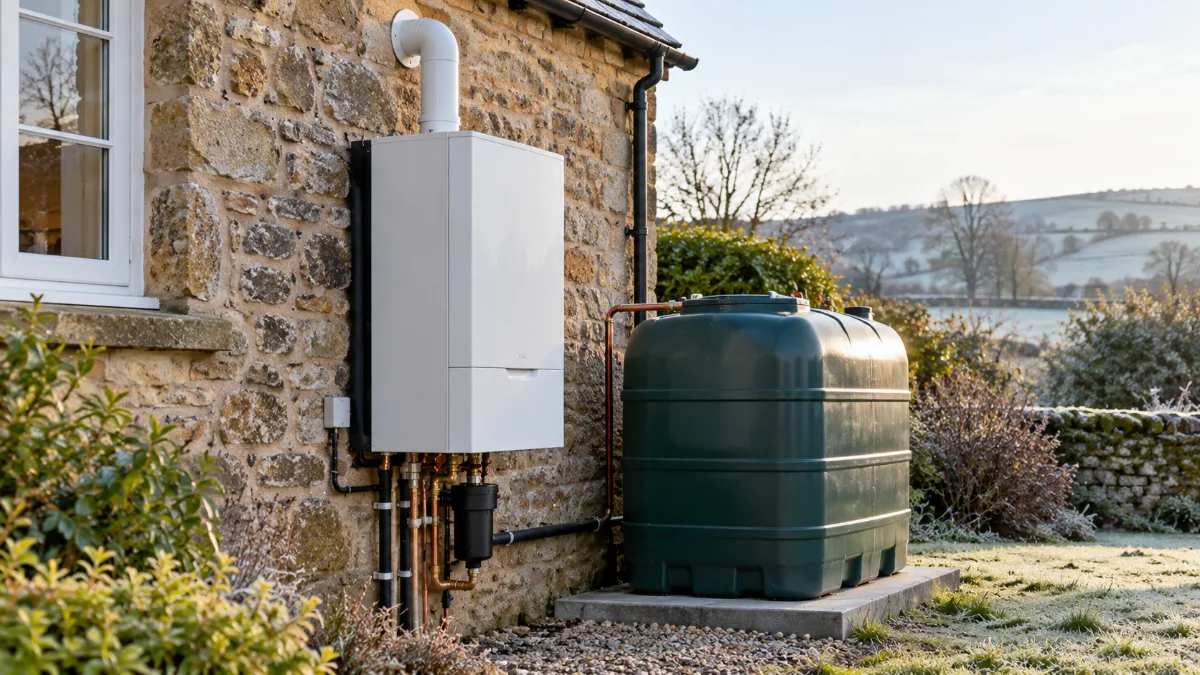
The difference is that oil boilers can also go outside. An external boiler sits in its own weatherproof casing against the wall, which frees up a cupboard indoors and keeps the burner noise out of the house. Our job in Pensford is a good example of one.
How long does an oil boiler last?
There’s no fixed number, but a decent oil boiler that’s serviced every year should give you 15 years or more. Plenty go well past that.
What kills them early is neglect. Skip the annual service and the nozzle wears, the burner gets sooty, combustion gets worse and the heat exchanger starts to clog. Water getting into the tank and through to the boiler doesn’t help either.
You’ll usually get warning signs before one gives up for good:
- It’s slow to fire, or takes a few attempts.
- There’s a smell of oil or fumes in the house.
- It’s sooting up or smoking at the flue.
- It’s started locking out and needing a reset.
- Your oil seems to be going down faster than it used to.
None of those should be ignored. A smell of fumes in particular needs an engineer, and you should have a working carbon monoxide alarm near any oil boiler.
Why people stick with oil
If you’re off the gas grid, the alternatives are LPG, electric heating or a heat pump. Oil’s still the most common choice in rural homes for good reasons.
It heats a house quickly, and kerosene gives you a lot of heat per litre. You own the fuel in your tank and can shop around for a delivery when prices drop. A modern condensing oil boiler is also a big step up from the old ones it usually replaces.
The downsides are worth knowing too. You have to keep an eye on your level and order before you run low. The tank needs looking after, and oil prices can jump about. And if you run out, it can be a fiddle to get the boiler going again.
Servicing an oil boiler
Oil boilers need servicing every year, and it’s a bigger job than a gas service. The engineer changes the nozzle and the filter, cleans the burner and the heat exchanger, sets the electrodes and checks the combustion with an analyser.
They should also check the fire valve, the oil line and the tank. Make sure whoever services it is OFTEC registered. We explain the differences in more detail in gas vs oil boiler servicing.
Oil heating around Bristol, Bath and North Somerset
Head out of the city into the Chew Valley, the villages south of Bath or out towards the Mendips, and you’ll find plenty of homes that aren’t on mains gas. A lot of them are older stone cottages and farmhouses, often with thick walls, big rooms and a boiler that’s been there a long time.
In older properties like that, an oil boiler is often the most practical way to get decent heat into the house. When it’s time to replace one, we’ll look at the tank too, because there’s no point putting a new boiler on the end of a tank that’s past it.
Frequently asked questions
Do oil boilers need a carbon monoxide alarm?
Yes. Any boiler that burns fuel can produce carbon monoxide if something goes wrong, and oil is no exception. Fit an alarm in the room with the boiler, or close by if it’s outside, and test it monthly. If it goes off, open windows, get everyone out and call an engineer.
What happens if I run out of oil?
The boiler will lock out. Once a delivery arrives, it can take a little while for any sludge stirred up in the tank to settle, and the oil line may need bleeding to get air out before the boiler will run. If it won’t restart after a reset or two, call an OFTEC engineer rather than keep resetting it.
Can I replace my old oil boiler with a new one?
Yes. There’s nothing stopping you replacing an existing oil boiler with a new, more efficient one. An OFTEC registered installer can also self-certify the work, so you don’t need a separate visit from Building Control. We’ll check the tank, the oil line and the flue position as part of the survey.
How often should the oil tank be checked?
Have it looked at during the annual boiler service, and keep an eye on it yourself between times. Look for cracks, bulging, rust on steel tanks, weeping joints and a strong oil smell around the base. A leaking tank can be expensive to clean up, so problems are worth catching early.
Need help with your oil boiler?
If yours is getting old, playing up or overdue a service, give us a ring on 01275 400 687 or send us a message and one of our OFTEC registered engineers will come and take a look.