







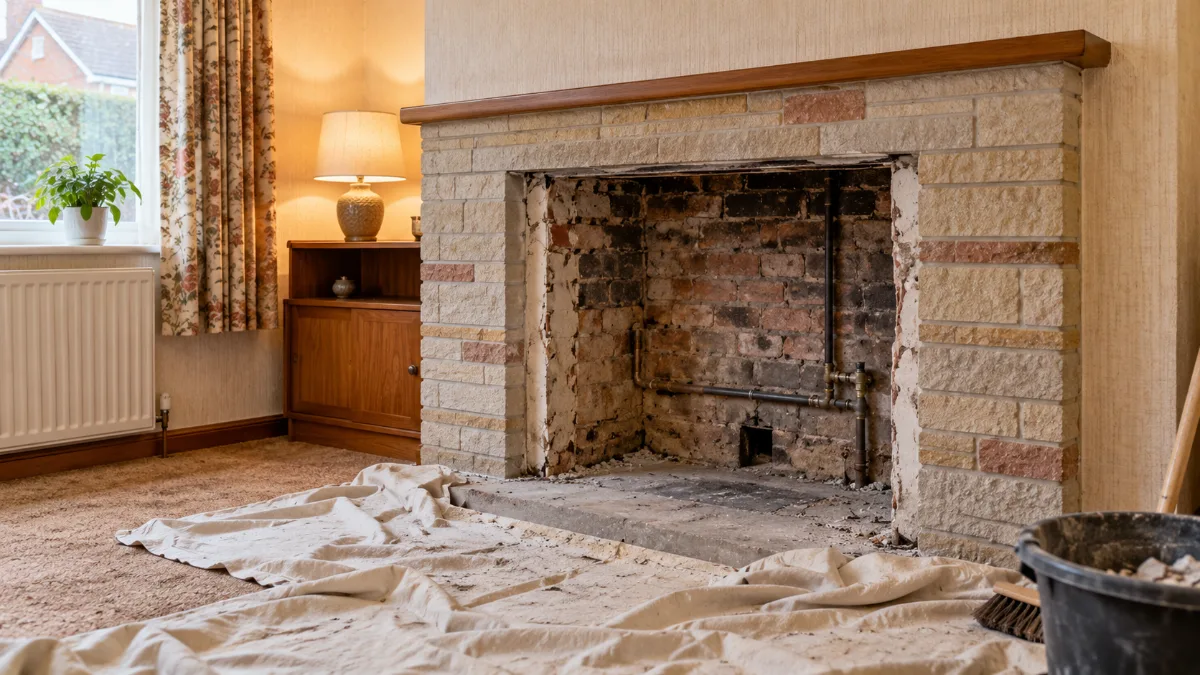
If you’ve got a gas fire in the living room with a hatch at the bottom, there’s a fair chance there’s a back boiler hiding behind it. They went into a lot of homes from the 1960s through to the 80s, and we still come across plenty of them around Bristol and Bath. Taking one out is a bigger job than a normal boiler swap, but it’s usually done in a day or two and you’ll get the fireplace back too. Here’s what the job involves, step by step, and why most people don’t regret it. For prices and what’s included, see our back boiler replacement service.
Can you still buy a back boiler?
No, not a new one. Since 2005, Building Regulations in England have required new gas boilers to be high-efficiency condensing models, and the old back boiler design doesn’t meet that.
You can sometimes still get parts for existing ones, but they’re getting harder to find every year. When a back boiler finally fails, replacing it with another isn’t an option. That’s why it’s worth planning the change before it breaks, rather than in the middle of a cold snap.
Why people take them out
Efficiency is the big one. A back boiler sends a lot of its heat up the chimney. A modern condensing boiler captures most of that heat, so more of the gas you pay for actually warms your house.
You also get the room back. The fire and boiler go, and you’re left with a fireplace you can do something with.
And there’s peace of mind. A back boiler that’s 40-odd years old is running on borrowed time, and when it goes there’s no like-for-like replacement waiting.
The job, step by step
The survey
We’ll come and look at the boiler, the fire, the chimney, your hot water setup and where a new boiler could go. Then you get a written quote.
Draining down and removal
On the day, we isolate the gas and electrics and drain the system. Then the fire comes off and the back boiler comes out of the fireplace. They’re heavy old lumps of cast iron, so expect some mess. We put dust sheets down and clean up after ourselves.
If anything looks like it might contain asbestos, such as old fire surrounds, flue linings or the boards behind the fire, we’ll stop and get it tested before going further. It’s not common, but in homes of that age you have to check.
Making the flue and chimney safe
The old flue gets decommissioned and the chimney is either capped or left ready for whatever you want to do with the fireplace next.
Fitting the new boiler
The new boiler usually goes somewhere more sensible: the kitchen, a utility room, the airing cupboard or the loft.
If you’ve got a hot water cylinder, you can keep it and go for a system boiler, which suits busier households. Or you can take the cylinder and loft tanks out and go for a combi. That frees up the airing cupboard as well.
Flushing and commissioning
Back boiler systems are often old and dirty inside, so the radiators and pipework need a good clean before the new boiler goes on. We fit a magnetic filter to keep it that way, then commission and test everything.
Paperwork
We notify Building Control and register the guarantee with the manufacturer. Most jobs take one to two days, and you’ll be without heating and hot water while we’re working.
What happens to the fireplace
That’s up to you. Most people go one of four ways:
- Board it up and cap it, then decorate over it.
- Keep the opening as a decorative feature.
- Put in a log burner or an electric fire.
- Leave the opening exposed, made safe.
If you want a log burner, it’ll need a proper liner and installer, so have a think about it before we finish. It’s easier to plan it now than to undo things later.
What does it cost to run compared to a new boiler?
We can’t give you a figure without seeing your house and how you use your heating. Your current bills will tell you a lot, though. The older and less efficient the back boiler, the bigger the difference a condensing boiler makes.
What we can say is that the install costs more than a standard swap, because of the extra removal work and pipework. Have a look at our guide on how much a new boiler costs for the general picture, and finance is available if you’d rather spread it.
Back boilers in Bristol and Bath homes
They’re common in 1960s and 70s houses, a lot of ex-council homes and semis from that era included. Some older terraces had them put in when they were modernised too.
Many are still going, which says a lot about how they were built. It also means that when one finally gives up, it’s usually in winter, when everyone’s heating is working hardest.
Frequently asked questions
Can I stay at home while the back boiler is removed?
Yes. Most people do. You’ll be without heating and hot water while we work, which is usually one to two days, and there’s some dust and noise when the old boiler comes out. If it’s cold we can talk about what to do to keep the house comfortable in the meantime.
Do I need Building Regulations approval?
Fitting a new boiler is notifiable work, but you don’t need to sort it out yourself. As Gas Safe registered installers, we notify Building Control on your behalf and you’ll get a completion certificate once it’s done.
Can I keep my gas fire?
Not the one attached to the back boiler, because they come out together. You can have a new gas fire fitted afterwards if the chimney and flue are suitable, but it’ll be a separate appliance and needs to be fitted and checked properly. Plenty of people go for a log burner or electric fire instead.
What if my back boiler breaks before I’ve booked a replacement?
Call us as soon as you can. Some faults on back boilers can still be repaired if the parts are available, but if not, we’ll get you booked in for a replacement as quickly as we can and talk you through options for heat and hot water in the meantime.
Ready to get rid of your back boiler?
Ring us on 01275 400 687 or get in touch online and we’ll come out, have a look at what you’ve got and give you a free written quote.