







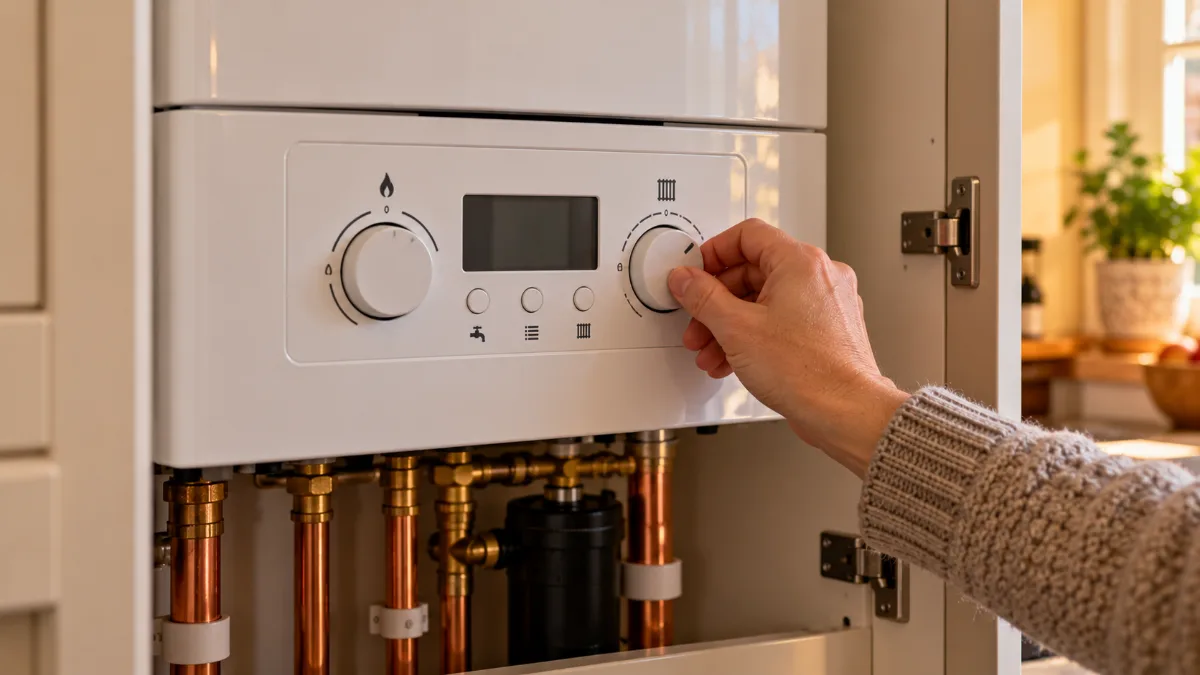
Most people know where their thermostat is. Far fewer have ever touched the dial on the boiler itself. That dial sets the flow temperature, which is how hot the water is when it leaves the boiler on its way to your radiators. In a lot of homes with a condensing boiler, turning it down a bit helps the boiler run more efficiently without the house feeling any colder. It’s something we’ll happily check and set up for you during a boiler service, along with a few other easy ways to make your heating go further this winter in Bristol and Bath.
Flow temperature isn’t the same as your thermostat
These two get mixed up all the time.
Your room thermostat decides how warm you want the house. Say, 19 or 20°C.
The flow temperature decides how hot the water in the radiators gets on its way to doing that.
A high flow temperature heats rooms fast with scorching radiators. A lower one heats more gently with warm radiators. Either way, the thermostat still switches the heating off when the room gets to the temperature you’ve set.
Why a lower setting helps a condensing boiler
Almost every gas boiler fitted in the last 15 years or so is a condensing boiler. It’s designed to pull extra heat out of its exhaust gases by cooling them down until the water vapour in them condenses.
That only works properly when the water coming back from the radiators, the return temperature, is cool enough.
Set the flow temperature too high and the water comes back too hot. The boiler still heats your house, but it’s not condensing much, and it’s burning more gas than it needs to. Plenty of boilers are left on a high setting from the day they’re fitted.
Should you turn yours down?
Combi boilers
Most combis have two dials or settings, one for central heating and one for hot water. The heating one is the flow temperature.
A lot of households try around 60°C and see how the house feels over a few days. If the rooms still warm up well, you might be able to go a bit lower. If it’s not keeping up in a cold snap, nudge it back up.
System and regular boilers with a cylinder
Be more careful here. On many of these systems, the same flow temperature heats your radiators and your hot water cylinder. Stored hot water has to be kept hot enough to control bacteria like legionella, so don’t just turn it right down. Ask your engineer what’s safe for your system.
Heat pumps
Heat pumps run at much lower flow temperatures by design and have their own settings. This is about gas boilers.
What you’ll notice
Radiators will feel warm rather than too hot to touch, and rooms may take a little longer to come up to temperature. You might want the heating to come on a bit earlier in the morning.
If some rooms never get comfortable, the radiators there may be too small for the room, or the system may need balancing. Our guide to bleeding and balancing cold radiators shows you how.
Other ways to heat your home more efficiently
Flow temperature is just one setting. These all help too, and none of them cost much.
Use your radiator valves. Thermostatic radiator valves let you keep spare rooms cooler and the rooms you use warmer.
Get your timings right. There’s no point heating an empty house all day. Set the heating to come on before you get up and before you get home.
Don’t block the radiators. A sofa pushed against a radiator, or long curtains hanging over one, traps the heat behind them.
Close curtains at dusk. Especially on single-glazed sash windows. It makes a bigger difference than you’d think.
Deal with the draughts. Gaps round doors, letterboxes and old floorboards let warm air straight out. Draught excluders are cheap.
Bleed the radiators. Air in a radiator means a cold patch and wasted heat.
Get the boiler serviced. A boiler that’s burning cleanly uses less gas to do the same job.
Bristol and Bath homes: does it suit every house?
Not always. A well-insulated newer home in somewhere like Portishead or Emersons Green will often stay comfortable at a lower flow temperature.
A draughty Victorian terrace, or a big stone house in Bath with small radiators, may struggle on the coldest days. That’s fine. Turn it back up a little during a cold spell and down again when it passes.
Frequently asked questions
Will turning the flow temperature down damage my boiler?
No. Boilers are designed to run across a range of flow temperatures, and lower settings are well within that. What matters is that the house still heats properly and, if you’ve got a hot water cylinder, that the stored water stays hot enough to be safe. If you’re unsure, ask an engineer to set it up.
Does it affect my hot water on a combi?
On most combis, no. The hot water for your taps and shower has its own setting, so turning down the radiator dial doesn’t change it. Check your manual to be sure which dial or menu does what, because the layout varies between makes and models.
How do I know what mine is set to?
Look at the front of the boiler. You may have a dial with a radiator symbol on it, or a digital display where you press a radiator button to see the setting. Some show numbers, others just a scale. Your manual will explain how to read and change it.
Want your boiler set up properly?
If you’re not sure what flow temperature suits your home, ring us on 01275 400 687 or drop us a message. We’ll check your settings when we service your boiler and explain the best setup for your system.